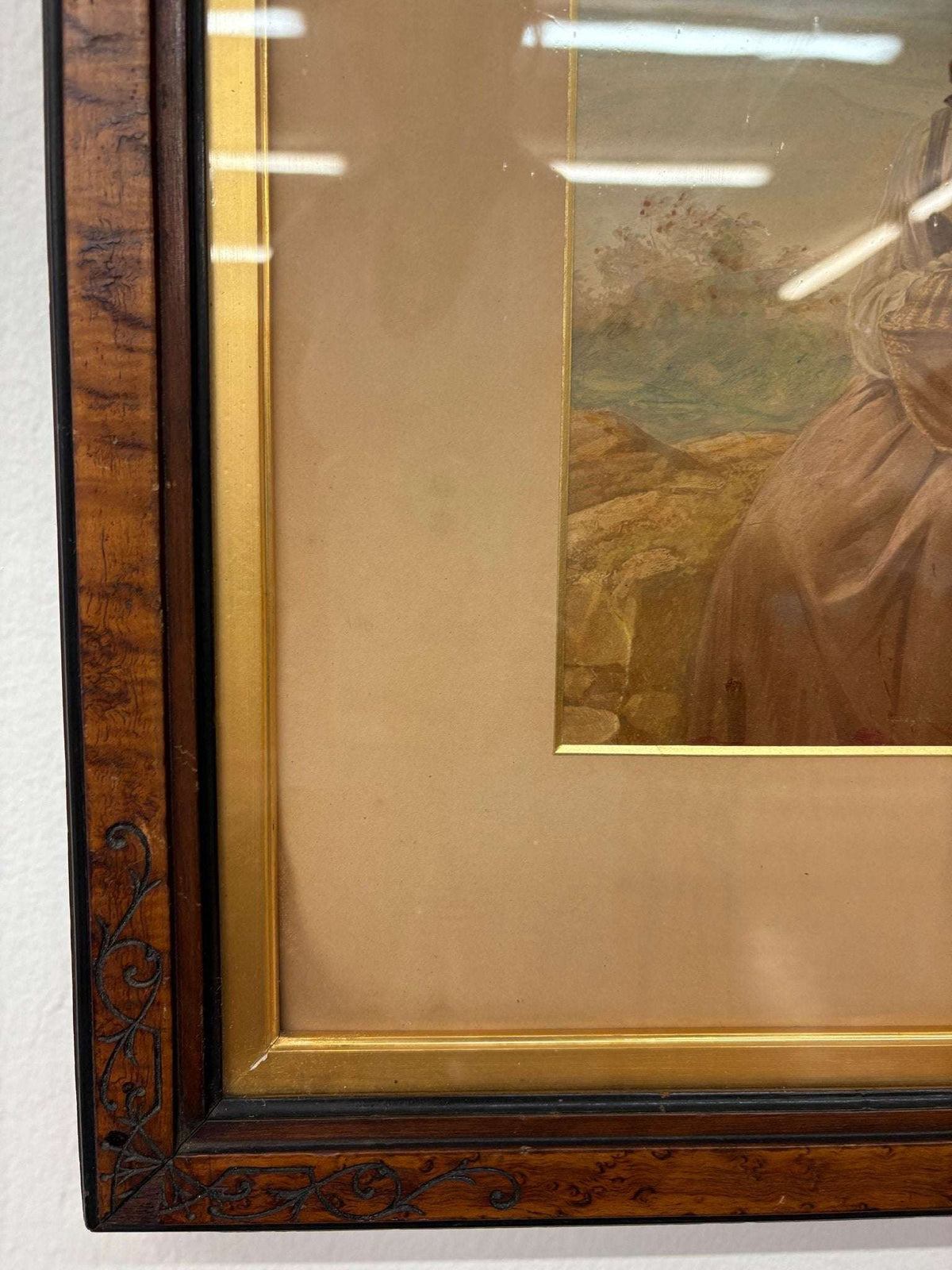
Meyer von Bremen Framed Chromolithograph — 19th Century German Girl Portrait
Couldn't load pickup availability
Johann Georg Meyer von Bremen (1813–1886) was one of the most popular German painters of his era — a Düsseldorf school painter who became a professor in Berlin, a member of the Amsterdam Academy, and a medal winner at the Philadelphia Exhibition in 1876. His specialty was tender genre scenes of rural German life, particularly figures of young girls and children in pastoral settings. His paintings found an enthusiastic market in both Europe and the United States, and chromolithographs after his work were widely produced and distributed during his lifetime for exactly this kind of domestic display.
This print depicts a young girl in rural clothing seated on a hillside, holding a basket, gazing softly ahead — a characteristic Meyer von Bremen subject in his characteristic palette of warm pastels and luminous sky. It is a chromolithograph, not a painting, which is what the original listing correctly states and what most examples of this type are. That honesty matters: this is a piece of 19th-century print culture, not a hand-painted work.
The frame is the other significant element. The original burl walnut veneer frame with ebonized and gilt detailing takes a small 8.5″ × 10.5″ image and presents it at 20″ × 18″ — the frame is doing substantial work here, and it does it well. Original mat, original glass, structurally sound.
Details
- Artist: Johann Georg Meyer von Bremen (1813–1886)
- Medium: Chromolithograph — color print, not a painting
- Subject: Young girl with basket, seated in hillside landscape
- Era: Late 19th century
- Frame: Original burl walnut veneer with ebonized and gilt detailing, under glass, original mat
- Framed: approx. 20″ × 18″
- Image visible: approx. 8.5″ × 10.5″
Condition Very good antique condition. Light foxing to the matting and gentle toning consistent with age — expected and honest for a piece over 130 years old. Frame structurally sound with surface wear and minor edge loss typical for its age. Ready to hang.
Placement On a gallery wall of 19th-century prints, in a library or reading room, above a desk — anywhere that benefits from something with genuine historical weight in a small footprint. The frame alone makes a statement; the subject gives it warmth.